Healing After Coercive Control: Reclaiming Your Self and Safety
Mar 24, 2026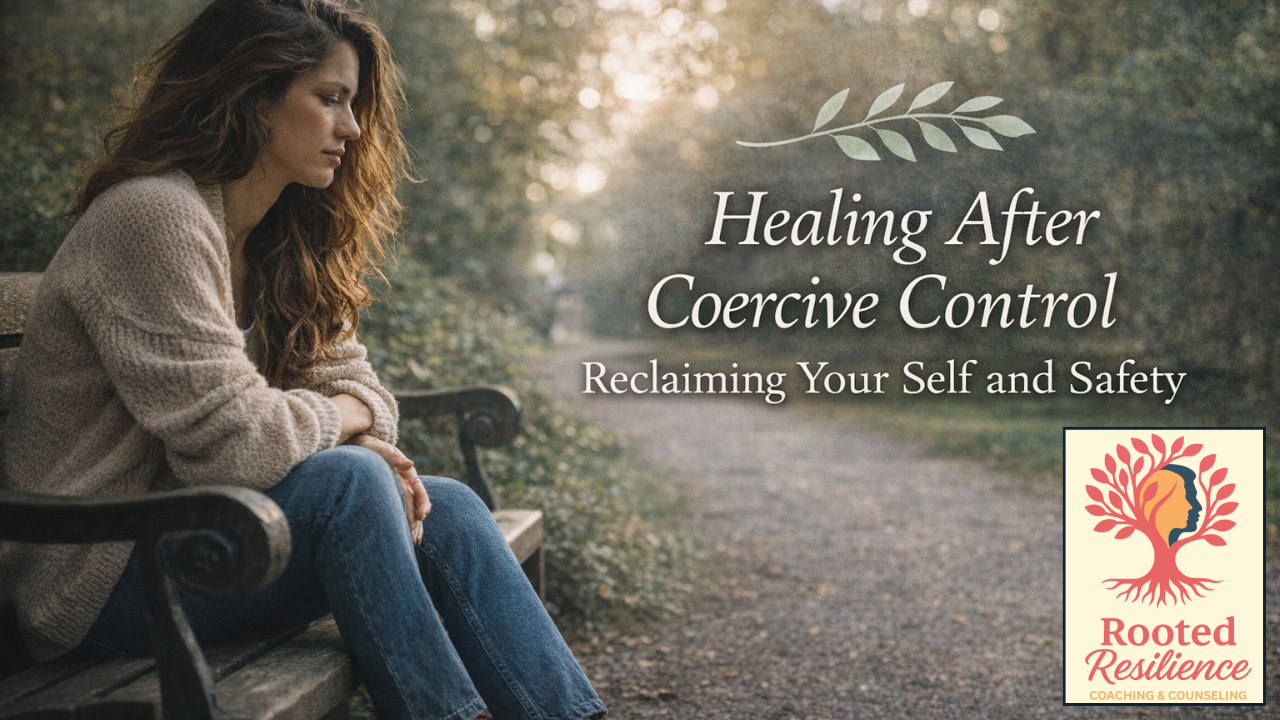
Leaving a relationship shaped by coercive control or emotional manipulation is not the end of the journey.
For many people, it is the beginning of a new and unfamiliar chapter.
Even after physical distance from the relationship, the emotional and nervous system patterns that developed during that time may still remain. You may notice lingering self-doubt, heightened anxiety, or moments where you question your instincts.
These responses are not signs that something is wrong with you.
They are signs that your mind and body adapted to survive a difficult relational environment.
Healing after coercive control is not about “getting over it.”
It is about reconnecting with yourself.
Understanding the Aftereffects of Control
Coercive control slowly reshapes how a person experiences themselves and the world around them.
During the relationship, you may have learned to monitor your tone, your reactions, or your decisions to avoid conflict. Over time, this can create patterns such as:
-
Doubting your judgment
-
Difficulty trusting others
-
Feeling hyper-aware of others’ moods
-
Fear of conflict or disagreement
-
Emotional exhaustion
These patterns are not permanent. They are learned survival responses.
With the right support and awareness, they can gradually shift.
Rebuilding Self-Trust
One of the most important steps in healing after coercive control is rebuilding trust in your own perceptions.
Manipulation often undermines confidence in your instincts. Gaslighting, blame-shifting, and repeated criticism can cause someone to question their memory, feelings, or judgment.
Healing involves slowly restoring that inner sense of knowing.
This may look like:
-
Listening to your emotional responses without immediately dismissing them
-
Allowing yourself time before making decisions
-
Practicing small boundaries in everyday situations
-
Noticing when your body signals discomfort or safety
Self-trust does not return overnight.
It grows through small, consistent moments where you honor your own experience.
Regulating the Nervous System
Relationships shaped by manipulation often create chronic stress within the nervous system.
You may find that even after leaving, your body still reacts quickly to perceived tension or conflict.
This is because your nervous system learned to stay alert in order to protect you.
Practices that support nervous system regulation can be deeply helpful during this stage of healing.
These may include:
-
Gentle breathing exercises
-
Spending time in calming environments
-
Movement such as walking or stretching
-
Journaling emotional experiences
-
Therapy or trauma-informed coaching
Over time, these practices help signal to the body that it is safe to relax again.
Reconnecting With Identity
Coercive control often narrows a person’s sense of identity.
During the relationship, your focus may have shifted toward maintaining peace or managing another person’s reactions.
Healing invites you to rediscover the parts of yourself that may have been set aside.
You might begin to ask:
-
What activities make me feel like myself?
-
What values matter most to me?
-
What relationships feel safe and supportive?
-
What kind of life do I want to build moving forward?
These questions are not about rushing into change.
They are about reclaiming personal space within your life again.
Learning What Healthy Love Feels Like
After experiencing coercive control, healthy relationships can sometimes feel unfamiliar.
This is because healthy connection often looks different from the intensity that manipulative relationships create.
Healthy relationships tend to include:
-
Consistency instead of unpredictability
-
Respect for boundaries
-
Emotional accountability
-
Open communication
-
A sense of calm rather than confusion
Healing allows you to develop a clearer understanding of what safe connection truly feels like.
And that clarity becomes a powerful guide for future relationships.
Moving Forward With Compassion
If you are recovering from a relationship shaped by manipulation or coercive control, it is important to remember that healing is not linear.
There may be moments of strength and moments of uncertainty.
Both are part of the process.
Your experiences do not define your worth, and they do not determine your future.
You are allowed to rebuild your life at your own pace.
And you are allowed to move toward relationships and environments that support your wellbeing.
Ready to Begin Rebuilding?
Healing after coercive control can feel overwhelming when approached alone.
At Rooted Resilience, we work with individuals who are navigating the complex process of rebuilding safety, self-trust, and emotional clarity after relational trauma.
You do not have to have everything figured out before reaching out.
You simply deserve support as you move forward.
Book a session or free consultation today to begin your healing journey.
Schedule here:
Stay connected with news and updates!
Join our mailing list to receive the latest news and updates from our team.
Don't worry, your information will not be shared.
We hate SPAM. We will never sell your information, for any reason.
